
Rückblick: 24.09.2025
Artist Talk with Tony Cragg
 © Photo: René Antonoff
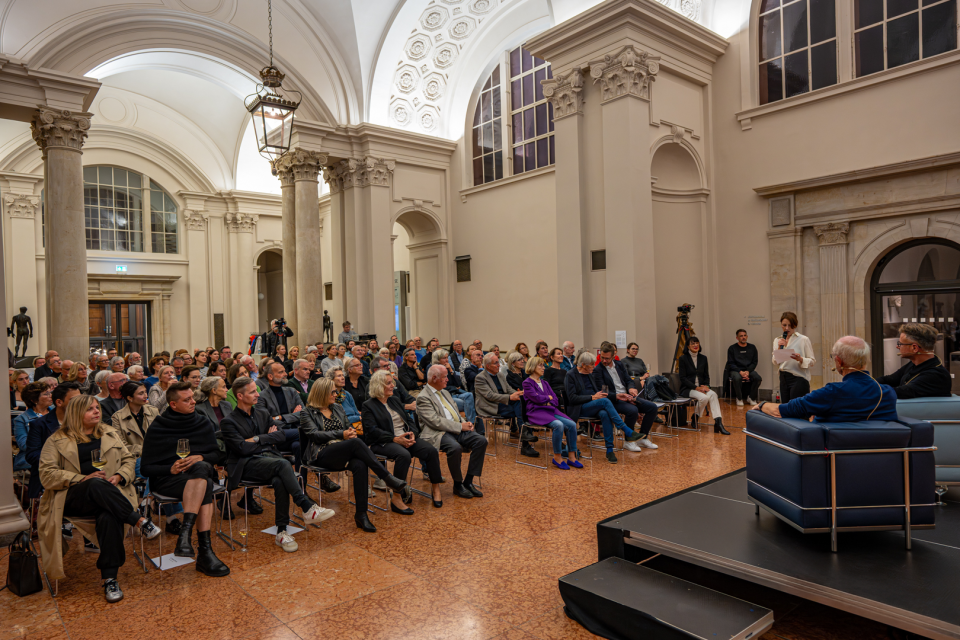
On September 24, 2025, around 120 guests experienced one of the highlights of the major TONY CRAGG exhibition in Darmstadt. Shortly before the end of the exhibition, the international sculptor spoke about material, form, and perception at the Hessisches Landesmuseum Darmstadt as part of the double exhibition in Darmstadt and Heidelberg.
At the artist talk on 24 September 2025 at the Hessisches Landesmuseum Darmstadt, Kathrin Thomschke, Head of Collections for Art of the 18th to 21st Century and Ethnology, welcomed the audience and recalled the museum’s long-standing connection with the British sculptor. The major exhibition A Natural Selection from 2016/2017 was still vivid in many people’s memories, as was Tony Cragg’s monumental sculpture in the museum’s staircase. »We are especially delighted to have the opportunity to welcome the artist back here this evening,« Thomschke told the 120 attendees.
Torsten Bruns, curator of the Skulpturengarten Spanischer Turm, also praised the successful collaboration within the framework of the dual exhibition, which in Darmstadt, one month before its closing, was approaching 40,000 visitors and was likewise receiving strong resonance in Heidelberg. The event, held just under a month before the exhibition’s end, was »one of the true highlights of this presentation« and was made possible through the support of numerous partners. The free tickets for the evening had been raffled in advance via the social media channels and newsletters of the Hessisches Landesmuseum Darmstadt, the Mathildenhöhe Darmstadt, the Spanish Tower Sculpture Garden, and the Sparkasse Darmstadt.
In the subsequent conversation with cultural journalist Dietrich Brants, Tony Cragg provided profound insights into his thinking and artistic practice. Right from the beginning, he emphasized how essential the direct, physical experience of his works is to him. He himself had »touched these works all my life,« he noted, while many museums forbid touching sculptures. People are constantly surrounded by material, he explained, often without noticing it: »We live in a permanent dialogue with material.«
Cragg further emphasized that form and meaning are inseparably linked for him. »There is no form without meaning,« he said, describing how even small shifts in line, surface, or volume can evoke entirely new sensations. His works do not begin with concepts, but with the act of making itself. He builds models from layers of industrial wood, screws them together, takes them apart again, and alters them until the expression is right: »I draw with the material.« Only afterwards do the finished forms receive a title.
A vital role in Cragg’s work is played by his lifelong passion for collecting – from fossils and stones to industrially manufactured plastic fragments. He does not regard these objects as waste, but as cultural traces. The industrial monotony of mass-produced forms is, for him, both a point of departure and a counterimage. His art is a conscious response to it: »We have impoverished the world of form. I wanted to create something that is more than just a sum of material.«
Time and again, Cragg directed attention to the invisible structures of our world. Nature fascinates him not through its outward appearances, but through forces, movements, and inner logics. A weeping willow in his own garden inspires him less as a tree than as a dynamic system in the wind. His sculpture Spring also emerges from this way of thinking, a term that for him simultaneously means coil, source, leap, and new beginning: »It is a fantastic word full of energy.«
Cragg ultimately summed up his fundamental attitude in one sentence that runs like a leitmotif through his work: »Everything is sculpture.« Every posture, every gesture, every thought is, for him, a sculptural phenomenon. Even neural processes are expressions of material in motion: »Without matter, nothing exists.« The roughly ninety-minute conversation ended with long applause.
For many of the 120 guests, it was an evening that enriched the exhibition—already a crowd-puller in both Darmstadt and Heidelberg—with a lively, personal dimension and cast an impressive spotlight on one of the most significant sculptors of our time.